
Materials Spotlight: The Bead Chain Cabinet
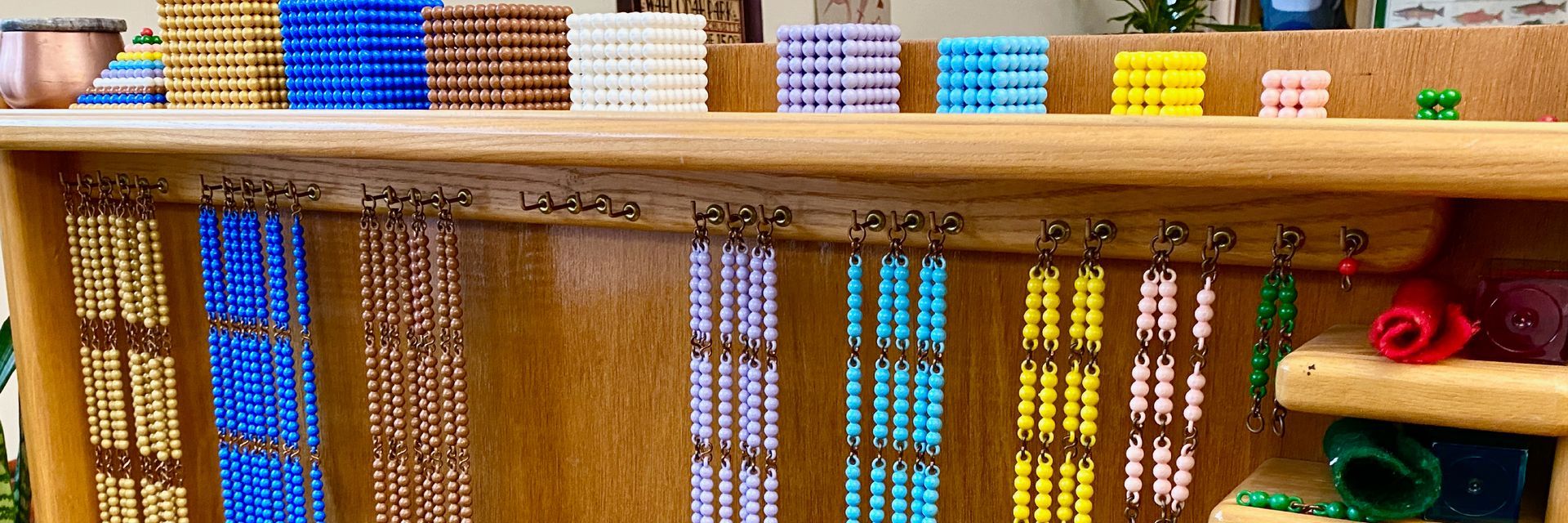
Visit any primary or elementary Montessori classroom and you’ll immediately notice a stunning display of colorful glass beads hanging in an open cabinet. Children (and adults!) are drawn to the order and elegance of the bead chains. Beyond their initial aesthetic appeal, the bead chain material offers an amazing array of intellectual opportunities for young children to those in their elementary years.
Color-coding
One of the brilliant aspects of the Montessori math materials is how they provide children with multiple ways to make neural connections. For example, each of the bead bars represents a quantity and each bead bar is also color-coded so that the quantity is connected to a color: a bar with two green beads represents two, a bar with five light blue beads represents five, a bar with eight brown beads represents eight, etc. This color coding allows the child’s brain to establish multiple quick ways to understand the quantity: the number of beads, the color, and the size.
Appealing
In Children’s House, young children are attracted to the beauty and fragility of these colorful, glass beads. Long before they are ready to use the bead chains, young children can learn how to dust and care for the beads. They develop a respect for the materials and understand how special they are. Often young children will watch in awe as their older classmates learn how to carry, lay out, count, and label the bead chains.
Linear & Skip Counting
As they practice counting the bead chains, four- and five-year-olds solidify their understanding of teen numbers, as well as quantities from units, to tens, to hundreds, to thousands. Eventually the focus of work with the bead chains shifts from linear counting to skip counting, as children begin to focus more on the labels that indicate the end of each bead bar. For example, on the 100 chain, children label and name 10, 20, 30, 40, 50, 60, etc. Children can also layout, count, and compare the 100 chain and 1,000 chain side-by-side, providing the sensorial experience of the different quantities laid out in a linear fashion.
Multiplying
As children move into their elementary years, they are solidifying their skip counting in relation to mastery of multiplication. They love to quiz each other by turning over some of the labels to see if their friends can figure out which of the multiples is missing. So for the short chain of multiples of seven, for example, they might turn over one label to see if their friend can figure out the missing multiple: 7, 14, 21, __, 35, 42, 49.
The bead chains are also used to provide an impression of common multiples, which is critical for future work with fractions. Children lay out two long chains side by side, label the chains, and then find all the common multiples, and also begin to intuit the concept of the lowest common multiple.
Squaring & Cubing
The other fascinating aspect of the bead chains is how they geometrically represent the concept of squaring and cubing. Children learn how to fold up the bead chain so that it creates a square made up of four rows of four: 4 x 4 = 16.
This work can continue with the long chains, each of which creates the cube of numbers one through ten.
In addition to the hanging chains of bead bars, the bead chain cabinet also contains beautiful squares of each number, which can be stacked to create cubes, as well as the actual cubes for each number. The squares and cubes can be used for explorations with powers of numbers as well as more advanced work when students start to explore working outside of the base ten number system.
As children move into more advanced mathematics, they will often briefly revisit this foundational material to cue their memory when working with exponents.
Spiral Curriculum
The bead chain materials provide a perfect example of the spiral nature of the Montessori curriculum. From early linear counting, cycling into an understanding of multiples, to preparation for squaring, cubing, and base number work, children come back again and again to the beauty and breadth of the bead chains.
We invite you to visit our school to see the bead chains for yourself!