Understanding Equivalence: A Montessori Approach to Math Insight
In Montessori mathematics, we often talk about three key ideas that help children make sense of geometry: congruence, similarity, and equivalence.
Of these, equivalence is the most powerful and the most far-reaching.
Mastering the concept of equivalence lays the foundation for understanding area and volume, supports the Pythagorean theorem, and ultimately prepares children for deeper work with fractions and algebraic thinking.
Children don’t need to have mastered fractions to begin exploring equivalence, but a bit of early fraction work helps them make connections more fluidly. Most importantly, they need time, space, and hands-on materials to discover these relationships for themselves.
What Is Equivalence?
At its heart, equivalence means that two shapes, while different in appearance, occupy the same amount of space. They have equal value in terms of area.
The word itself comes from two Latin roots:
- aequus, meaning equal, and
- valere, meaning value.
So “equivalent” quite literally means equal in value.
This idea might sound straightforward to us as adults, but for children, it becomes most meaningful through concrete exploration.
A Peek Inside the Montessori Lesson
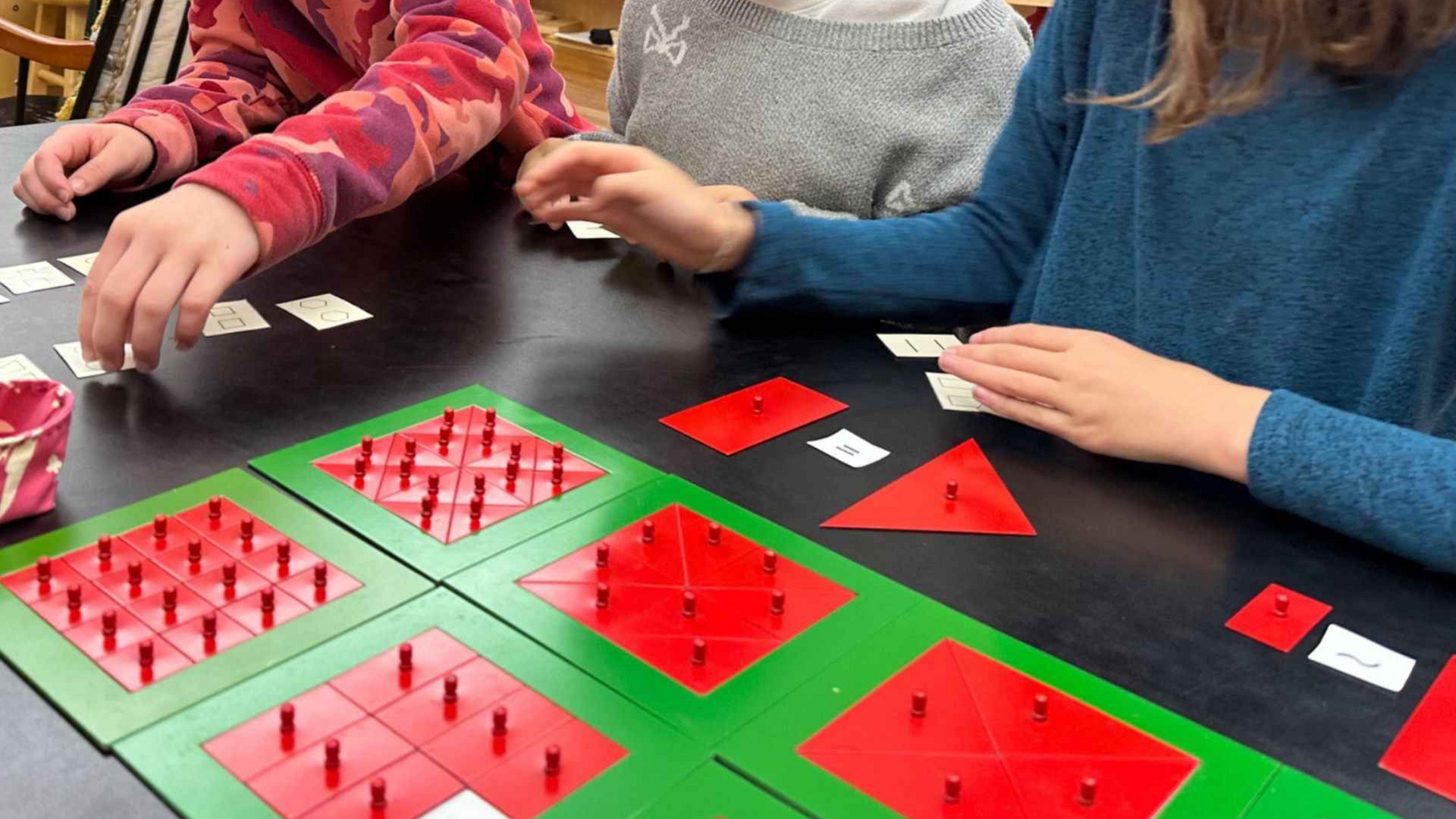
When introducing equivalence, we begin by laying out geometric insets, first with the pieces in their frames, then outside the frames, which provides experience with how shapes relate through direct manipulation.
We place a large square frame on the table. Then we fit two large rectangles (each of which make up half of the square) inside it. They fill the frame exactly. Next, we remove the rectangles and place two large triangles (again which form halves of the square) into the same square frame. They fill it just as perfectly.
Although the shapes differ, they take up the same amount of space. Each piece is half of the whole. They are equivalent.
Children then compare individual rectangles and triangles, seeing that while the shapes look nothing alike, they still share the same “value” within the whole. This comparison is what allows children to eventually understand that shapes can be broken apart, rearranged, or recombined and yet still hold the same area.
For children who need a more tactile entry point, we offer tracing, cutting, and checking that the two different shapes take up the same amount of space. Children love proving to themselves that different shapes can represent equal areas. It is mathematical reasoning born from their own discoveries.
Exploration: The Heart of the Work
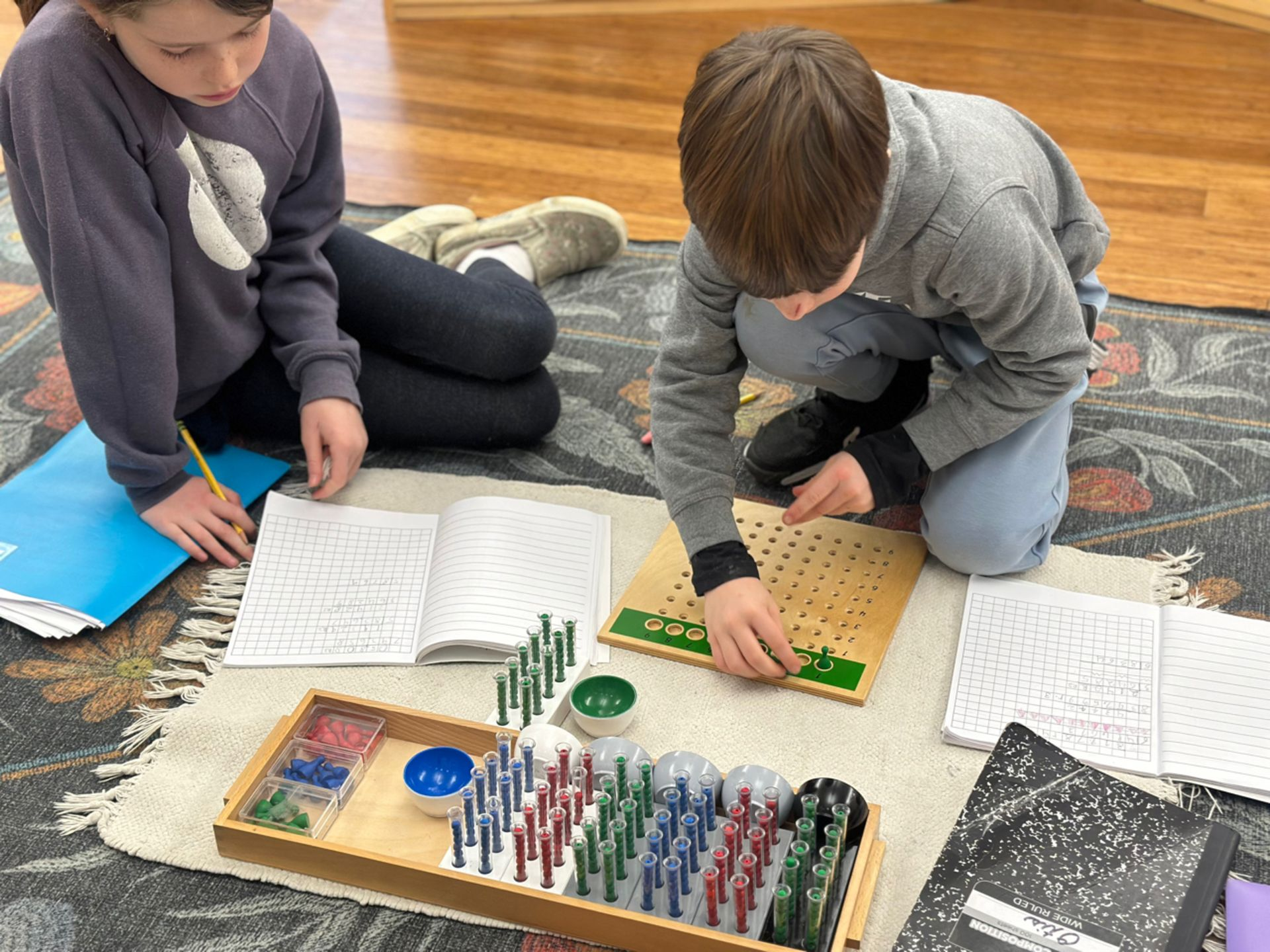
Once the basic idea is introduced, the real learning begins as children explore with different shapes and combinations of shapes. In addition to manipulating the pieces, they can trace, cut, check, rearrange, question, and try again.
This is where true learning happens because humans learn through our hands! Children get to embody abstract concepts. In Montessori education, children learn by doing, not by memorizing.
Introducing Mathematical Symbols
Later, once children are comfortable identifying congruent, similar, and equivalent shapes, we introduce the symbols that represent each concept.
We often begin the lesson with a simple invitation:
Can someone find two congruent figures?
Can someone find two similar figures?
Can someone find two equivalent figures?
After the children place each set on the table, we add the symbols:
- The equal sign between two equivalent figures.
- The similarity symbol between two similar shapes.
- The congruence symbol, a combination of the two, between congruent shapes.
This prepares children to use these symbols in their own booklets, charts, and geometric discoveries. It also helps children see how math is a language and that it can communicate relationships clearly and beautifully.
Why This Work Matters
Equivalence becomes a cornerstone of later mathematical thinking. When children can transform shapes, make comparisons, and see underlying relationships, they build the insight needed to derive formulas for complex shapes or to understand why the Pythagorean theorem works.
Using these materials inspires curiosity, fosters the ability to see relationships, and provides firsthand experience with the logic of the universe. And that is the essence of Montessori math!
Come see for yourself how joyful geometry can be!
Visit us here in Lenox, MA!